Showing posts with label seasonal. Show all posts

Monday, 27 July 2009

Feeling flowery in veggie heaven

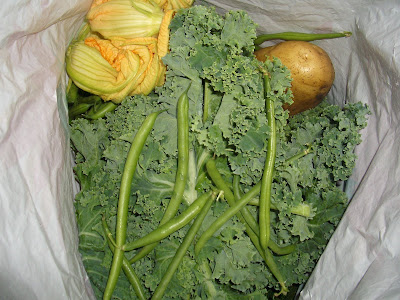
Last week I took part in Dan of Food Urchin’s dinner blogging challenge (called ‘Where’s my pork chop?’). Basically I cooked him some dinner and in return I got, well these:

There loads of potatoes, beans and courgettes hiding under the kale

I’m going to be blogging what I cooked for Dan in a separate post so check back for that in the next few days. Here I want to tell you some of what I’ve done with the veg so far.

Dan had been down to his allotment bright and early on the day of the swap and picked me a selection of goodies in their prime. In the bag were charlotte potatoes, curly kale, green (French) beans, courgettes and COURGETTE FLOWERS ☺. I’d been hoping for some of the latter as I’ve only tried them once before and they aren’t that easy to buy. We’ve tried to grow our own courgettes this year but we aren’t having much success so far (the first lot of seeds didn’t germinate) so I was particularly delighted with the flowers.

Of course as everything had been picked only a few hours before I took the picture above the veg were absolutely bouncing with freshness. I was pretty pleased with my haul and it really demonstrated how lovely and fresh veg can be when their distance from the ground to the kitchen is short. I now have allotment envy.

So what I have I done with the veg so far?

Well as recommended by Dan I did some of the kale with oil and chilli. I actually steamed it first then gave it a quick sauté in rapeseed oil and chilli flakes. It was really good, the kale still had a little bit of crunch to it and the chilli complemented the slight bitterness that is inherent in brassicas like kale. I’ll definitely try it like this again and venture out into varying the spice choice as well.

The potatoes are just brilliant. One of my gripes about potatoes is that its not that easy to get ones that taste of anything much but when you do WOW instead of thinking potatoes taste kind of bland and nothingy you realise they have an earthy sweetness all of their own. Dan’s potatoes hit the mark on this – I assume its because they were straight from the ground. So far we’ve had them simply boiled and also crushed and cooked with some onion. Yum.

The beans and the courgettes we’ve steamed and tossed in a little oil or butter – again when things are this fresh they can shine on their own.

And the flowers?


Well searching in cookbooks, on the internet and tweeting all seemed to point to stuffing the flowers, dipping in a tempura batter and deep-frying. Hmmmmm. I’ve never deep-fried anything; I don’t own a deep fat fryer, I too vividly recall close calls with chips pans in the 1970s (and that safety advert they used to run) to suddenly think that deep-frying them is the way to go. I also don’t want to experiment with a new technique on my precious courgette flowers – imagine if it goes wrong…..after a bit more thinking and searching I decide to just have them fresh and perky as they are in a salad but I do go with the flavours that many of the deep fried recipes suggest i.e. fresh soft cheese and herbs.


I simply tore the flowers and tossed them with the rest of the salad (rocket, basil, lollo rosso, tomato, cucumber) before adding some of my favourite Buxlow Wonmil cheese and drizzling with a little oil. The flowers aren’t particularly strong in flavour but they add a both a different colour and texture to the salad. They are curiously soft yet slightly crunchy at the same time and a good addition.

I guess if I get more flowers I might dare to experiment with deep-frying but for now I’m happy I stuck to adding my flowers to a salad. (Dan – more flowers please….)

Sunday, 12 July 2009

An unexpected glut of cherry plums

Of what? Of cherry plums. What are they then?

The simple answer is they are plums that look like cherries and the trees can be found planted in many a street and garden mostly across the southern half of the country.

But you want to know more than that don’t you? Well then if you are sitting comfortably I shall begin.

© Danielle Harlow - Fotolia.com

We’ve lived in our house for nearly 12 years and when we arrived the garden was a bit ramshackle. It had been nice at one point I’m sure but the previous owner was rather old (he had lived his whole life in the house) and it had been left to get overgrown. Both garden and house were in need of a LOT of work. It was a great chance to start from scratch and not have to live with someone else’s idea of the ‘perfect’ terraced house. So we set to work. It took the best part of 8 years for the house to be completely finished and a bit like the Forth Bridge it’s now time to start decorating all over again (no walls to re-plaster though this time).

But I digress.

We have also made plenty of changes to the garden. Sadly the greenhouse hidden at the end was too rotten to save and the pond a little too large to look after. So they went. There were plants that were past their prime or couldn’t survive the severe trim they needed and others we didn’t know what to do with (or didn’t like - pampas grass anyone!). One of these was a quite young looking tree that didn’t show much promise; it was bolting for the light through the trees in our neighbours’ garden. The initial decision was that it would probably have to go. But we didn’t get round to it and then it was February and the tree came into blossom way before anything else giving a wonderful feeling of the approaching spring and providing some brightness in a wintery garden.

The tree in blossom earlier this year

So it stayed. And each year the blossom has been wonderful, sometimes as early as January but never later than the end of February. The blossom is white and because it comes so early I started to assume maybe it was some kind of almond tree.Then we started to get fruit, not many at first and often hard and green with a small stone. It didn’t really look like an almond and I never got very far in trying to find out what it was.

Plums on the tree in mid June

Then this year I became determined to find out what it was. I was spurred on by my day of wild food foraging but it wasn’t until I got a copy of The Forager Handbook (thanks @RachieGraham) that I was finally able to work out what it was. Some cross checking on the internet to confirm and just as the fruits started to be ready I knew at last that it is a cherry plum and that it is edible. And this year there seemed to be quite a lot of fruit.

Just some of the haul

So I started to collect the fruit, and I carried on collecting them, and on and on and on and on and on. And over about 3 days I collected about 15kg (I lost count somewhere I think). And then I needed to process them because eating 15kg of fruit straight off was not going to be a good idea. A couple of tweets later and I had recipes for pickled plums (thanks to @Weezos) and plum chutney (thanks to @TheAmpleCook) and some possible giveaways that in the end couldn’t be managed. Naturally I already had in mind some of my almost legendary fruit vodka so I got to work. Oh my and what work it was.

Bucolic England (Flatford Mill, 2007. copyright Jonathan Taylor (Flickr user Northstander)

When I was a ‘corporate slave’ I harboured dreams of having a little chutney and preserves business, because when you sit at a desk most of the day building spreadsheet models, writing reports and trying to keep 150 very nice solicitors in check your mind roams off into bucolic styled dreams of country England and domestic pursuits such as baking bread and making chutneys. Every now and then I would rustle up a batch of some kind of chutney and dish it out to delighted friends and family – it all seemed such fun. Well let me tell you its not so much fun if you have to do it day in day out. And I say that after only 2 ½ days of plum processing! I reckon that each kilo of plums equated to about 180 actual plums.

Just some of the 2700 plums I stoned

So I’ve stoned 2,700 plums BY HAND. I’m surprised I haven’t developed RSI. And the thing is I reckon I only got about ¼ of the total possible harvest…why? Well the tree is against our fence so half of the branches are over next-door’s garden so there’s 50% I didn’t get and then I was only collecting those that fell and were in good condition and weren’t under a prickly shrub. I took a peak under one of the shrubs and there were loads more under there so I reckon I lost another 25% that way (of the total not of the remainder – see what all those years with spreadsheets did to me). So I guess the tree had roughly 60kg of fruit on – not bad for what used to be a gangly upstart that we nearly got rid of. 

Now I have pickled plums, plum chutney, plum vodka, plum compote, bottled plums (in sweet syrup) and I’m still collecting about 500g a day……more vodka with them I think as that’s the easiest to make.

Here's the final haul

So if you’ve got a plum or damson tree watch out because I think it’s going to be a bumper summer. And if you’ve not well then don’t go too mad at the fruit farm 2½ days of fruit processing is more than enough for anyone.

Here’s some ways to deal with your own fruit glut. I’d also recommend The River Cottage Preserves Handbook for good ideas.

My Legendary Fruit Vodka

I don’t use fixed measure for this but ratios.

Select your fruit of choice and weigh it. They tip it in a large glass jar (e.g. a preserving jar with a clip lid).
Add between half to the same weight of sugar (I usually used granulated) depending on how tart the fruit is and how sweet you want the result to be.
Then pour over about 1 ¼ -1 ½ times the volume of vodka as you had weight of fruit; so if you had a 750ml bottle of vodka you’d be looking to find between 500-600g of fruit.
Add any extras you think you’d like, a shaving of lemon peel is good with damsons or sloes.
Stir it all round to get as much as the sugar to dissolve as possible.
Close the jar and leave for a minimum of 6 weeks.
Check regularly and shake to help the sugar dissolve. After the first 6 weeks test the flavour and either leave to extract more flavour or strain and bottle.
Leave the bottle to mature for a further few months minimum. It gets better with age if you can resist for long enough.

Tips:

  • If you haven’t got a large glass jar but have a glut of fruit you need to use up quickly then put everything a big non-reactive pan, cover and then track down a jar – it’ll be fine for the first few weeks in a pan.
  • You can use gin instead of vodka but remember gin already contains its own aromatics so you’ll get a different flavour. Sloes and damsons work particularly well with gin.
  • If the fruit is quite hard then you need to break the skin to allow the flavours to mix – I do this by putting the fruit in a large freezer bag and bashing it a bit with the rolling pin. If you’ve stoned the fruit (or its a soft fruit) then there’s no need to do this.
  • You might want to strain through muslin or even a coffee filter before bottling if you want a really clear result. If you don’t mind sediment there’s no need to bother.
  • Be wise whom you share the vodka with; once people have tried some they’ll always be angling for another bottle.

Plum Pickle (adapted from a series of Tweets by Weezos)


1kg plums
1ltr wine vinegar
500g sugar
100g salt
spices of your choice

Salting the plums

Stone the plums and place them in bowl sprinkling salt over each layer as you go. Leave for 12-24 hours.
Sterilise glass jars in an oven for 10 minutes at R2/150C and leave to cool.
Bring the vinegar, sugar and spices to the boil and simmer for 5 minutes. Allow to cool.
Rinse the salt from the plums and pack in jars. Cover with pickling vinegar.
Seal and allow to mature for a minimum of two weeks (longer is better) in a cool place.
Good with terrines and game dishes.

Spiced Plum Chutney (thanks to TheAmpleCook)

Nearly ready for the jars

This recipe is from Delia Smith.

3lb plums
1lb apples
3 onions
3 cloves garlic
2 heaped tsp ginger
1lb seedless raisins
1lb soft dark sugar
1lb Demerara sugar
1 pint vinegar (recipe says malt I used cider)
2 tbsp salt
2 cinnamon sticks
1oz allspice berries
1 dsp whole cloves
large non-reactive pan
6 jars

Note: you can adapt the spices to a mix of your favourites but you need roughly the same quantity, for example I had a smoked chilli in mine, and coriander because I like them.

Put the spices in a muslin square and tie it tightly with string.
Stone the plums, finely chop the apples (cored but leave on the skins), finely chop the onions and put them all in a large pan.
Crush the garlic and add it, the raisins, ginger, sugars and vinegar to the pan. Sprinkle in the salt and stir well.
Suspend the whole spices in their ‘bag’ into the pan and tie to the handle for easy removal later.
Bring to the boil and then simmer pour about 3 hours until the vinegar has almost disappeared and you have a thick, soft chutney. Remember to stir occasionally to prevent sticking.
Sterilise the jars and fill whilst both they and the chutney are still warm.
Leave to mature in a cool place for a minimum of 3 months.


Tuesday, 9 June 2009

A walk on the wild side

“Here, turn right here, this has got to be it”.

We swerve round the corner and bounce along the driveway. “Nice pond, but where’s the big house?” There’s plenty of rolling parkland and a cluster of outbuildings but no grand house to be seen.

There’s also a tall affable looking chap wearing wellies and a big chunky jumper so we slow up and roll down the window. “Here for the food foraging?” he says, “follow the track round between these buildings and you’ll see a group of parked cars and over to the right people on the lawn, that’s were you need to be.” So we drive on as instructed and sure enough there’s about 15 cars and a bunch of people standing about having coffee. I get out and amble over and my husband drives off to a day of peace and quiet.

At last, I’m at Food Safari’s first foraging event at Henham Park in the depths of rural Suffolk.

I get a coffee and Polly (half of the duo that makes up Food Safari) passes me some still warm flapjack (yum! this is a good way to start) then introduces me to the rest of the group – none of whom I’ve met before but some of whom I’ve been chatting to via twitter (yes that's you @Farctum and @EssexGourmet). Once everyone is here Tim (the tall affable chap in wellies, he’s the other half of Food Safari) tells us the format of the day. We’re going to be foraging for wild foods here on the estate and then also down by the river Blyth (also on estate land) then we’ll be off to The Anchor at Walberswick for a lunch show-casing some of the wild foods.

Tim hands over to Jacky (aka WildFoodie) who’s our foraging expert today. She explains that we are on private land so sadly we can’t entertain any thoughts of popping back sometime to bag some more goodies; well I guess not unless we can get to be new best friends with Hektor who manages the estate, I imagine he’s probably got enough friends already though. Jacky also explains that the weather in Suffolk has been so dry recently that we probably aren’t going to find enough stuff in really good condition for us to take bagfuls home. We are going to have to be content to watch and learn, that’s the nature of foraging, it’s a real luck of the draw thing. Jacky had a scout about yesterday so she’s got lots of examples to show us and she’s been able to collect enough goodies for our meal later.

Then we move on to our first spot, I’m expecting we’re going to have to walk a good distance across the park perhaps into a wooded area, but no, there’s plenty to see only steps away from where we are. Take a look - what can you see that’s edible?

Hmmm looks like a bunch of weeds in a badly tended garden if you ask me…..but hold one we are going to find at least FOUR, yes that’s four, edible goodies in this patch.

Okay so clearly I’m in nappies on the foraging front compared to the likes of Jacky – I can’t see a thing I’d fancy eating. But with Jacky’s expert guidance we learn about ground ivy, cleavers (aka sticky willy – hmmm), nettles, ground elder, burdock and elderflower – blimey that’s six – and I don’t think Jacky was even trying hard….she tells use how to identify each of them through look, feel and even sound and also which bits to pick and even how to pick (clever scissor movement with your fingers for nettle tops). We taste as we go when things are okay to eat raw. Mostly everything we test has a fresh but quite bitter taste but there are differences between them.

Next its time to move on to the river. But before that a few of us think a comfort stop might be good so Polly takes us over to the stable block, which has been converted into a rather lovely looking B&B, and we get to use the facilities there. I also get a quick lesson in the intricacies and long running feuds of the Rous family and learn that the final version of the big grand house was knocked down (some say a fortuitous fire…) in 1953, so that’s why we couldn’t see it. There are plans afoot for a new house to be built.

Anyway down to the river – I would say bank but here the estuary is really wide and flat so it’s more like a gentle slope. The estuary systems in Suffolk and Norfolk are havens for all sorts of things and in particular marsh samphire

If you look really hard you can see the samphire at the front of this picture

I’ve had this before, bought from local farm shops and I love it. We are a little early in the season but we can see the samphire starting to sprout like some kind of mini primeval forest. We get to test the samphire and its wonderfully juicy with a salty tang –I’m looking forward to it being available in the farm shop soon and hoping we get some at lunch. We also find sea purslane which looks a bit like a succulent version of sage although it tastes nothing like sage. Again it’s juicy and salty.

Sea Purslane

And finally we head off to The Anchor pub at Walberswick with our appetites suitable whetted. But before we get to tuck into lunch we take a quick look at the pub’s allotment where Jacky tells us about poppy leaves (nice and sweet and almost pea like in flavour), hops shoots, dead nettles and chickweed (plus other assorted things you might just throw away but can actually eat!).

At last it really is time for food. We wander over to the beautifully refurbished stable block and are served with glasses of refreshing elderflower scented beer from Lowestoft whilst nibbling on fresh asparagus, tempura hop shoots and absolutely wonderful chickpea and samphire mini pancakes. These are so divine we are nearly knocking each other out of the way to get our hands on them; I’m definitely going to be trying to recreate them at home.

Mark then guides us into the stable block itself where a huge long table awaits us and a further three courses of food with matched beers. Mark is an absolute mine of information about the beers and clearly likes to surprise his guests with things such as a Gueuze he describes as having aromas of sweaty horse saddle and horse piss - great! Hektor and I try to tell him that we are not especially familiar with either of these but to no avail. Food wise every thing was delicious but dishes and flavours that particularly stood out were the chicken of the woods in the risotto, 

The chicken of the woods is the pinky/orange bits

a very meaty mushroom that might make some vegetarians shudder, the semi pickled carrots in the salad, the elderflower panacotta

and finally my favourite local cheese, Buxlow Wonmil. It makes a change to have lovely food paired with beers rather than wines and is something I might try myself. Of the beers I think my favourite was the Frambozen although the Gueuze was much nicer than Mark's description would lead you to expect; its kind of nicely tangy and refreshing, a bit like liquid sourdough.

Its time for everyone to head their separate ways, full of new knowledge, exceptional food and plenty of beers. I have a glass of Benedictine for the road (fortunately my husband is collecting me) and we waddle off clutching our information packs, happy foragers that we now are. 

You can find out more about Food Safari’s days out in Suffolk on their website, arrange gift vouchers for loved ones or simply book a treat for yourself. I’m hoping to try another one of their days soon.

To view the menu and other information about The Anchor at Walberswick click here. Go on treat yourself to some great food and beer.

Sunday, 10 May 2009

In season: more asparagus


A few weeks ago I treated myself to a 'Tarte Maison' tin from John Lewis. Its a lovely thing, 3 times as long as its wide and calling out to have something pretty made in it. Initially I'd intended to make a rhubarb tart that I'd seen Jonathan (aka @Browners), over at 'Around Britain with a Paunch' mention on Twitter. I've not got to the rhubarb tart yet - mainly because we don't eat that many desserts so it just hasn't happened.

But this weekend I thought it would be nice to do something a little bit different with asparagus that still let it shine and played to its best qualities but moved away from simple steaming and dressing (much as I love it just steamed).

The tart tin seemed just the thing to show off the asparagus.

It was quick and easy:

1. Steam 10 asparagus spears until tender and then immediately plunge them into cold water so they retain their vibrant green colour. Cut each spear in half so you have a bottom end and an end with the tip on.
2. Grease the tart tin and then line with four layers of filo pastry (I needed 8 sheets which overlapped in the middle). Pour in baking beans and blind bake for 7 minutes at Gas 6/200C/400F. Remove from oven and careful remove the baking beans. Allow to cool slightly.
3. Lay the bottoms of the asparagus spears in the pastry case. Add soft goats cheese cut into small pieces (I used 100g of Pants y Gawn). Pour in beaten and seasoned eggs (it took 6 medium eggs).
4. Lay the tops of asaparagus spears on the eggy mix. Bake 20 minutes at Gas 6 until the mixture is firm. Allow to cool, admire, slice and serve.

Thursday, 30 April 2009

Under the clock, with the flowers


Yesterday I had an assignation at Liverpool Street Station in London with a man I'd never met before called Dan (at least that what he said his name was). 

We agreed to meet at 11.30 BST.

He said I'd recognise him by the flowers and the gentle aroma of garlic. How he was going to identify me we didn't establish. Gave me plenty of get out but not him.

Fortunately there aren't that many people just standing looking like they are waiting for a man bearing a wild garlic plant at that time of day - most people are busy rushing to or from somewhere. Me, I was just loitering.

Anyway along came a guy with a garlic plant and I reasoned there wasn't going to be 2 people doing this so I said 'Hi' and as luck would have it it was Dan! We chatted bit, Dan told me about how to look after the plant and what to expect. We compared foodie notes. I handed him a sample of my home made sloe vodka (vintage 2006) as a thank you and he went off to carry on his day job (and sneak a nip of vodka I think) and I took the garlic for a coffee followed by lunch - most enjoyable and not too many odd looks.

The plant is now at home, the cats have checked it out and decided its not for them, I sampled some today at lunch and was impressed, so next up is to plant it at the shady end of the garden and hope that next year we have a good crop.

I can't wait for a feast of wild garlic next year :)

With big thanks to Dan over at FoodUrchin for giving me a little bit of his garden.


Monday, 27 April 2009

In season: asparagus, part 1


The asparagus season has been going for a week or so now and so far I’ve only had one tasting just over a week ago and none since. It was great but once only is not good enough, there are only 6-8 weeks of the season, I refuse to buy asparagus out of season and I love the stuff so I really need to get focussed – I mean I’d eat it everyday if I could! So today, despite the heavy rain and blustery wind, I decided it had to be asparagus for lunch, preferably with some Jersey Royals alongside. A quick trip to the supermarket was required - now I know I should be buying this stuff at the local farmers shop/market/etc but:

a. there isn’t one near me and
b. its Monday so time is short for food shopping.

I got what I needed – a good bunch of asparagus (it was from Hampshire – I’m really wondering where the East Anglia asparagus is this year after all its nearer – so much for Waitrose’s local sourcing policy!) and a small bag of Jersey Royals (and what happened to them being sold still in the soil it seemed so much better and they had them like that last year?).

Anyway back home with my haul of goodies I set to work to make a quick lunch. I like my asparagus simply done –I’m not one for turning it into soups it always seems best to me steamed or maybe grilled and then dressed with some oil or butter, or served with simple accompaniments such as poached egg, or a little cheese. Today I opted for steaming it above the potatoes and then serving it on a bed of parma ham, drizzling it with olive oil and sprinkling with a little bit of Sacanova Aged Mahon cheese, the potatoes were alongside with some oil and fresh mint.

Sweet and slightly nutty asparagus, earthy, nutty potatoes, sweet ham and a salty caramel tang from the cheese - perfection.

With only about 45 days left to get my fill how shall I have tomorrow’s asparagus?

Saturday, 18 April 2009

Quince blossom


Lets hope that it all turns into quinces and the squirrels don't steal them this year.....

Tuesday, 14 April 2009

Very easy rhubarb ice cream


As the sun has been out quite a bit over the last few weeks my mind turned to ice cream making. I don’t make lots of desserts or do lots of baking – I enjoy it but we just don’t eat dessert that often so it kind of gets wasted (this is not some ‘health’ or ‘no sugar’ things its just I prefer munching on savoury stuff these days); but every now and then a sweet dish is just what’s needed.

There are some really good ice creams out there especially at farm shops – enough really to make you wonder if home made ice cream is worth it, but of course it is – it’s a great project thing and good for impressing guests (or just your other half).

I’ve been a fan of Alder Carr Farm’s Alder Tree ice creams for a good number of years and when I get the chance I indulge in a little pot, sometimes insisting on a stop off at their farm shop just to get my hands on one. My favourite flavours are; Gooseberry and elderflower, Raspberry, Stem ginger and rhubarb and Summer fruits – its so hard to pick. Anyhow, we went for a walk near Blythburgh the other day and I was hoping for an ice cream treat at the end, but we were later than expected due to a route diversion and so there was no hope of getting my mitts on any ice cream anywhere ☹

Okay a big disappointment – but there are always ways to compensate and so I started planning some ice cream making. I’d picked up some rhubarb at the farm shop and hadn’t decided what to do with it so, with the cogs in my head whirring into action, I settled on either rhubarb and elderflower or rhubarb and pink ginger ice cream. I generously allowed my husband to pick between these two choices and he went for the ginger option.

This is so easy to make you won’t believe it! You’ll need:

rhubarb - a couple of sticks
4 tbsp pink ginger cordial (I used Thorncrofts)
100g of greek style yoghurt
100g of crème fraiche (basically half of the standard size tub)
an ice cream maker (much easier) or a strong plastic box and a freezer (slightly harder)

What to do?

1. cut the rhubarb up pretty small – about 5mm thickness max – you don’t want big stringy bits of rhubarb in your ice cream. Then simmer in about 2tbsp of water (no sugar) it until its soft and breaks up easily (10-15 mins should do it). Leave it to cool completely.
2. when its cool mix in the 4 tbsp of pink ginger cordial (undiluted); or of course elderflower cordial if that’s what you fancy. Check the taste and add a bit more if you like things extra sweet.
3. stir in the yoghurt and crème fraiche – it’ll be pretty sloppy
4. fire up the ice cream maker if you have one and pour in the mixture, allow to churn. It’ll take at least 30 minutes to get to a good frozen but soft scoop consistency. Eat.
5. if you don’t have an ice cream maker then first of all get on to your loved ones and drop hints that you’d quite like one – the ones where you freeze the bowl start at around £35, if you’ve got rich loved ones make noises for one that has its own freezing unit (£220+). Then once you’ve done that put the mix in the plastic box, put it in the freezer and take it out every now and then to stir it as this breaks up the ice crystals and mkes for a smoother consistenty, probably every 2 hours will do it. It’ll take about 8 hours if you can wait that long.

Enjoy, and feel smug.

Monday, 13 April 2009

In season: wild garlic

Wild garlic had been popping up on my radar for a couple of weeks as being very much in season and ‘very now’ i.e. a thing it seems we should aspire to be seen eating. Never one to want to miss out on an emerging trend I thought I’d best give it a go.

I didn’t fancy going off to forage for it – it mostly grows in woodland and by river banks – neither of which are that common in East London (and those that there are you’d probably not want to harvest wild garlic from). It’s apparently easy to identify with mid to dark green glossy leaves about 6 inches or so long and the garlicky smell is a give away – I remember that from woodland walks in Wales. Anyway I thought I’d keep an eye out to see if there was any on sale.

Eventually I struck lucky at the farm shop in Middleton, Suffolk – no I didn’t go to Suffolk to find wild garlic I was going anyway- there it was for sale by the bag looking pretty fresh and perky to me.

I did a bit of searching around for suggestions as to how to use it – most books and sites saying it could be substituted for chives or garlic though its milder than the latter. Spring herb soups also seemed to be recommended and salads. All good sounding stuff. After a bit more thinking about how to incorporate it into our meals over the next couple of days I decided on two different options:

Sautéed with a mixture of chard and kale to give a flavoursome mix of greens (about 1/3 of each would be about right). I chose to use rapeseed oil (which I’m currently switching to for quite a lot of my cooking, and because I was challenging myself to get as much of the meal locally as possible). I served it as a side dish with chargrilled lamb cutlets and new potatoes. It was pretty good but as I had only used about ¼ wild garlic and as the cooking softens the flavour it was a little bit lost – I’d try it with 1/3 wild garlic next time I think and perhaps add it after the other greens to preserve more of the flavour.

The second time I used it I decided to do a warm potato salad with a vinaigrette made from 1 part white wine vinegar to 4 parts extra virgin rapeseed oil and a teaspoon of wholegrain mustard all shaken in a jar. I did lots of potatoes (local grown Charlotte – so a good waxy salad potato) and after simmering them for about 15 minutes I allowed them to drain for about 10 minutes (covered) before tossing them in the dressing then adding the chopped wild garlic and tossing again. This was really very good. The warm potatoes brought of the garlic flavour well and they were nicer, I think, than either spring onions or chives done in the same way – spring onions can be too harsh and chives not strong enough – the wild garlic was just right. It was just as good next day cold.

So if you can get your hands on some wild garlic, either foraging or from a farm shop, then give it a go. These are two simple recipes to get you started but there’s lots of other good ideas out there too. I’ll certainly be trying it again.

Thursday, 9 April 2009

In season: mussels

Last night I had mussels just as they should be – wonderfully fresh, plump, sweet and with a tang of salty sea-ness about them. Cooked in the classic style of mariniere – butter, white wine, shallots, parsley and served with crusty bread to mop all the delicious juices.

I have to confess I didn’t cook them myself – I’ve always been a bit scared about preparing shellfish at home, maybe I just need to find a reliable local source and give it a go. The instructions in books always seems a bit of a faff – lots of leaving the shellfish in a bucket of water for days (!), swooshing them round to get out any grit, tapping them too see if they are dead or alive (and I don’t mean the 80s band from Liverpool), scrubbing, scraping etc etc, all before you get to cook them for about 5 minutes. I like the hard work to be done by someone else sometimes and I just do the eating.

So these were my starter at Regatta in Aldeburgh (after a bracing walk and a quick pint of Adnams). I followed them with salt beef, home made piccalilli (homemade by the team at Regatta not by me!) and new potatoes. But the mussels had been so lovely and such a generous portion (the amount some places would give you as a main to be honest) that I stalled part way through the salt beef – and now I’ve got a little take out to make a sandwich with for lunch tomorrow ☺.

I’d say these were the best mussels I’ve had by far ever and I’ve eaten a fair few in my time. Just goes to show how good local produce (there’s plenty of mussels produced on the Essex and Suffolk coast) fast from the producer to the table can be. So good I might even venture to cook some myself this season.

No pictures sorry, was too busy eating!

Sunday, 5 April 2009

British seasonal resources

When I did my G20 menu post (where I looked at whether Saint Jamie had delivered or not menu wise at the G20 dinner) I promised that I would put some resources up for you so here is a selection of recommendations:

For checking out what’s in season/cooking the seasons try the following:

Internet:

Eat the Seasons
BBC What’s in Season
River Cottage Seasonality Table
Waitrose British Seasons


Books that are organised by season:


Hugh F-W: The River Cottage Year (great stuff and quirky as ever - love this book)
River Café Cookbook Green (based more on Italian seasons so just shift by roughly 6-8 weeks in most cases)
Gary Rhodes: The Complete Cookery Year (can be a bit complex but Gary knows his stuff)
Margaret Costa: Four Season’s Cookery Book (its been around a long time but there's some great ideas in this)
Jeremy Round: The Independent Cook (buying tips, recipes - useful reference, tho if you get the Pan paperback I think the index has gone wrong!)
Jamie O: Jamie at Home (recipes and growing tips, usual OTT enthusiasm from Jamie - love him or hate him)
Nigel Slater: The Kitchen Diaries (what Nigel ate almost day by day for 1 year, good on leftovers)
Matthew Fort: Rhubarb and Black Pudding (some of the recipes here are quite complex as it's about Paul Heathcote’s restaurant but they are good for inspiration)
Sally Clarke’s Book (again a restaurant related book but inspiring none the less)

If you’ve spied a particular ingredient that's in season and fancy looking at a few inspiring recipes for it try these books:

Sybil Kapoor: Simply British (some lovely quirky recipes in here)
Nigel Slater: Real Good Food (Nigel comes up trumps again)
Simon Hopkinson: Roast chicken and other stories, Roast chicken and other stories (second helpings), Gammon and Spinach (these are all great, good recipes, delightful commentary)
Rose Prince: The New English Table (wonderful approach to sustainable, ethical, frugal food)

and if you are after a bit of background history to dip in and out of then take a look at (there are other great books out there that are a ‘proper read’ but these are really good for snippets – some have recipes some don’t):

Jane Grigson’s Vegetable Book (a classic must have book, bit out of date in some of the comments/recipes but well worth it for the background info)
Jane Grigson’s Fruit Book (as for the vegetable book a must have)
Jane Grigson: English Food (some great background info)
The Oxford Companion to Food (essential for any real foodie)
Jane Grigson: The Observer Guide to British Cookery (whirlwind tour round Britain with recipes)
Dorothy Hartley: Food in England (quirky, slightly mad book but very interesting)
Mason/Brown: Traditional Foods of Britain (useful and fascinating catalogue of foods that are produced in Britain rather than ingredients)

and in looking for these I found Marguerite Patten’s Century of British Cooking which is a great canter through some of the things we’ve eaten as a nation decade by decade – might need to cook my way through it as a project!

I’m going to be adding these to the sidebar in due course so they are always to hand for you.

And I’d really love to hear what books and resources you rate for all that British and seasonal when it comes to food so please add your comments.

Saturday, 4 April 2009

A simple lunch

I’ve been blogging now for a couple of months and I’ve been looking at some of the other food blogs out there to see what goes on in the food blogging community. I noticed that some bloggers run ‘events’ as part of what they do and I thought it might be fun to join in now that I’m starting to get used to (or possibly obsessed by) the whole blogging thing.

Early on I’d seen the ‘In the bag’ monthly event that is run jointly by Julia at ‘A Slice of Cherry Pie’ and Scott at ‘Real Epicurean’ and was disappointed to have missed out on the January deadline; then I got so absorbed in playing with my blog, adding (and subtracting) widgets, reading Blogging for Dummies, checking out other blogs - you all know how it is I guess you've been there too - that I didn’t spot February’s ‘bag’ until it was so close to the deadline I knew I wouldn’t have time to think something up.


So as not to miss out again I watched closely for March's bag to be announced and then got to thinking about what I could do with these three ingredients (leeks, cheese and eggs) which feature frequently in my cooking but, I immediately realised, rarely in one dish.

So off I went to do some researching in my various cookbooks.


As leeks seemed to be the key ingredient I started by looking for different ways with them that also used both eggs and cheese (for this first attempt I didn’t want to drop one of the ingredients even though you are allowed to, that seemed way too easy). There were plenty of choices with leeks and cheese and a few with leeks and eggs but little that combined all three beyond the inevitable leek and cheese flan/tart/quiche – delicious but very obvious – I was hoping for something a little different and also a dish that could perhaps become a new favourite in my cooking.

I did spot a leeky Welsh rarebit recipe in Hugh F-W’s River Cottage Year that looked rather tasty but decided it felt a little too much like a hearty winter dish and I wanted something that would work well as a fresh and light spring dish. I was also reminded how versatile leeks are, its so easy to fall to just steaming them and serving as a side dish when with a little imagination they could shine in their own right.

Some of the ideas that I toyed with along the way but discarded were (some of my general sources of inspiration are shown in brackets for those who want to pursue any of these):
  • Chargrilled leeks with shavings of a hard sheep’s cheese, or with a mayonnaise or hollandaise (Sybil Kapoor, Simply British)
  • Lightly steamed, dressed with a vinaigrette and finely chopped hard boiled egg (Hugh F-W, The River Cottage Year and Simon Hopkinson, Roast chicken and other stories)
  • A la grecque (Jane Grigson’s Vegetable Book and Margaret Costa, Four Seasons Cookery Book) – fundamental flaw with this one was that it didn’t use the eggs or the cheese – oops! But it is delicious.
  • With pasta in a kind of vegetarian carbonara style or with homemade pasta (using the eggs) and a leeky cheesy sauce (any Italian cookbook will help).
  • As a kind of French onion style soup with a nice melted cheese crouton (I think this was from a Jamie Oliver book where he does a three types of onion soup - I think its Jamie at Home but can't seem to locate it right now - sorry).
  • In a risotto (any Italian cookbook).
  • As a gratin….
And so it went on – lots of fun delving in recipe books, finding great ideas, discounting them because they either didn’t use all three ingredients or they didn’t seem to fit with the fact the weather was getting wonderfully spring like. I was beginning to think that I wouldn’t be submitting again this time…….

Then sitting flicking through River Café Cookbook Green, I noticed what seemed like

frittata after
frittata after
frittata

in the chapters devoted to March and April (with wild salad leaves, with sorrel, with spinach and prosciutto). Something started to stir – I really like frittata and other similar styles of omelette and I often cook one with a delicious fresh cheese called Buxlow Wonmil that I get when I’m in Suffolk.

There wasn’t going to be chance to get any of that particular cheese for this dish but I did want the refreshing tang that it has, so goats cheese seemed a possibility and thinking back to the leeky cheesy rarebit that I’d liked the sound of I remembered that Waitrose stock a Welsh goats cheese (Pant ys Gawn) that would fit the bill. I was beginning to feel like I might be in business. A spring frittata made with good British ingredients to be served, hopefully, with a side salad of early spring salad leaves (I was really hoping for some sorrel as I’d spied some in the herb section at Waitrose recently)

So off to the supermarket this morning to get the ingredients (sadly there isn’t a farmers market near where I live other than going into London to Borough market, which I love but rarely have time for, hence a huge reliance on the local Waitrose.). There was no sorrel left but I did find some English watercress and had to settle for some French lambs lettuce as none of the leaves seemed to be English just yet. So here’s the recipe.

For 2 as a light lunch you need:

4 medium eggs (organic for preference)
½ - 1 Pant Ys Gawn goat’s cheese (I used a whole cheese but see later) - or other fresh tangy soft cheese
1 slim leek
butter
milk
Maldon salt
freshly ground black pepper
Salad leaves of your choice

Make sure the grill is on and warm before you start

The Leek: Top and tail the leek and cut into chunks about 1 inch in length then slice these into quarters, rinse the leek thoroughly to remove any grit and drain or spin in a salad spinner. Heat a little butter in an omelette or other shallow pan (of about 6-7” in diameter). Add the leeks and allow them to soften for a maximum of 5 minutes, you are aiming for them to retain some of their crunch.

The eggs: break the eggs into a bowl; add a splash of milk and some salt and pepper. As soon as the leeks have softened a little pour the eggs into the pan and allow to cook slightly. Draw in parts of the sides a few times to create a little fluffiness in the texture. Once you think you have a good base but the eggs are still runny for most of the depth then…..

Add the cheese, which you have crumbled or cut into small chunks. Cook for a little longer and then pop the pan under the grill (be careful with the handle if its not heat proof) to cook the frittata from the top. This will take about 3-4 minutes if the grill is hot.

Remove from the grill and allow to cool slightly, slice and serve with your chosen salad leaves.

I was pretty pleased with the result, the leek flavours showed through well and they were soft enough but still with some bite, the cheese contrasted with them nicely and had a good tang and the salad leaves (dressed with just a little extra virgin rapeseed oil) made for a nice soft balance. I think probably the whole goats cheese was a little too much as the egg flavour was a bit lost so when I make this again I’d probably scale back to ½ of the cheese.

I really enjoyed the whole ‘In the bag’ challenge; it made me think about some ingredients differently, gave me chance to read lots of recipe books and generated lots of ideas for ways to have leeks that I’d either forgotten or not thought of before.

So I’ll be looking forward to whatever is ‘In the bag’ in April.

Wednesday, 1 April 2009

G20 antics

Police and protesters; they’re ranged up against each other outside the Bank of England spoiling for a fight about something, anything, important or otherwise.

Meanwhile over at ‘Word of Mouth’ (The Guardian’s food blog) the real action is already underway with journalists praising Jamie O’s menu for tonight’s exclusive dinner at No.10 and the posting populace getting very het-up about seasonality, authenticity, diversity and why oh why its Saint Jamie in the limelight again.

So lets just try to take a balanced look at things (because I’m sure Gordon and Barack will be aiming for balance today and tomorrow, if not dietary then economically at least).

The brief:

Mr Oliver has apparently been given a brief to create a menu that showcases the best of seasonal British food and cooking including finding things to represent each of the parts of the United Kingdom. Now some of you may think that ‘best’ ‘British’ and ‘food/cooking’ in the same sentence is something of an oxymoron and that St Jamie is a fool to have accepted the gig. But as we know from past form there is nothing like a challenge to get Jamie’s enthusiasm racing away with him and him saying ‘YES’ before anyone has any chance of stopping him. Even the imminent arrival of his third child is not enough to stop Jamie pouncing on this chance.

Remember it’s a BIG BIG GIG.

So as we proceed through this analysis of the menu lets remember the brief is ‘BEST SEASONAL BRITISH’ cooked for people from 20 different nations with all the restrictions that entails. Because if you were on The Apprentice doing this and you junked the brief straight off Mr Sugar would be firing you right back to where you came from in no time.

The menu:

You’ve probably seen it already but lets see if and how it sticks to the brief:

Starter:

Baked Scottish Salmon with Seashore Vegetables, Broad Beans, Herb Garden Salad, Mayonnaise and Wild Garlic-scented Irish Soda bread
OR
Vegetarian option is Childwickbury Goat’s Cheese with Roast Shallots, Seashore Vegetables, Herb Green Salad and Wild Garlic-scented Irish Soda Bread (no mayo)

Main:

Slow-Roasted Shoulder of Welsh Lamb, very first of the season Jersey Royals, first of the season Asparagus and Wild St George Mushrooms. Mint Sauce and Gravy
OR
Vegetarian option is Lovage & Potato Dumplings with first of the season Asparagus and Wild St George Mushrooms

Dessert:

Hot Bakewell Tart with Home-made Custard

A quick look in any seasonal cooking book or any of the various
online seasonality resources will show you that Jamie is potentially quite restricted in some areas e.g. fruit = pretty much nothing, meat = wild pigeon!. And once he has to factor in a whole range of dietary requirements the options get cut further. So lets just be clear here: the guy has to create something uniquely (and identifiably) British and WOW that fits with a plethora of dietary restrictions and a rather thin set of seasonal choices.

So his only option is to get top notch ingredients and try to make them sing.

Starter:

Salmon: in season, very recognisably British, represents Scotland (still part of the UK last time I looked despite the best efforts of may a Scotsman and woman). Obvious choice but shellfish is probably a no no and many might squeal at eel.

Seashore Veg: identified on most sites as sea kale and samphire. Well he’s on the mark with sea kale but I’m a bit doubtful about the possibility of samphire – it’s a shade early for that really but he can hardly have had it grown in a poly tunnel so he must know a secret source. I have seen it growing on the mud flats of Maldon fairly early in previous years so its not impossible. And its very British.

Broad beans: pretty British, very early so these have got to come from under glass, possibly from somewhere like the Isle of Wight or Channel Islands. And before we all go off on one about producing things early under glass lets just remember that they’ve been doing it since way back in the 1500’s – what do you think they used Chelsea for before they built posh houses and football clubs on it!

Herb garden salad: definitely seasonal, not especially British but that will depend on the actual herbs selected and what’s available. Hopefully he’ll have some sorrel or watercress or early spinach in there.

Mayonnaise: not reknowned for being particularly British but it is tasty and we could make a slightly weak argument about it allegedly being brought back from Mahon in Minorca after Richelieu defeated the British there in 1756 (bit tenuous though). I think he should have plumped for a dressing made with rapeseed oil and a herb or fruit vinegar.

Wild garlic soda bread: wild garlic is definitely in season and grows across much of the UK; and soda bread is found both North and South of the border in Ireland so it fits (regardless of your politics on the UK/Irish matter).

Vegetarians: sadly its goats cheese again for them it seems (a stock answer to ‘oh dear how do I cope with the veggie people’) but since good goats cheese is so lovely and a staple of the British food scene these days I’d be happy to opt for this and they get to have the same supporting vegetables.

Main: This is a tough one to call. The options are limited and some of the things on the menu are VERY early in the season. I imagine there’s been a lots of frantic sourcing going on to get some of this stuff but the choices are all well known British options and show the range of possibilities from across the UK

Lamb: of course it is now April! Its a bit early in the season but not impossible to get lamb that’s mature enough – I suspect since its being slow roasted it’ll be close to 1 year old rather than new season. Pretty tough call to find another option when pork and beef are probably both of the menu due to dietary restrictions and everyone would simply roll their eyes if its was chicken being served up.

Jersey Royals: if they are ready I say bring them on, fantastic.

Asparagus: after the cool winter I’m doubtful this is really in season yet but he must have managed to get its somewhere – I love asparagus so I’m quite jealous.

Vegetarians: good to see that the supporting notes are the same as for the meat option, veggies are so often just palmed off with a totally different mushed up irrelevant dish whereas this references back and adds lovage which will be in season.

Dessert: oh dear this is where the controversy really warms up. For a start most people say the real thing is Bakewell Pudding and it’s pretty easy to search out bucket loads of supporting evidence for that assertion. But many of the same sources also suggestion that Bakewell Tart is not such the chav newcomer most of us would have and recipes can be traced back at least to the mid 1800s for dishes that are more tart like less pudding and indeed tarts akin to Bakewell have a heritage going back further across most of the UK. So, as long as St J isn’t just opening a pack of Mr Kipling’s then I’m sure things will be okay. Pudding, dessert, whatever you want to call it there must have been lots of options to consider. I think he’s slightly lost the seasonal plot though here as he could have done something interesting with new seasons rhubarb (like the a wonderful dish I tasted at Northcote Manor in Lancashire earlier this year of Rhubarb Carpaccio, Custard Crumble Parfait, Rhubarb Granita which was real wow), even a simple fruit fool would have done the trick I think (and stopped the arguing about tarts and puddings).

So overall has he met the brief?

Well I’d say he’s well over 90% of the way there with this menu, plus its relatively simple and accessible and crucially for him straightforward to prepare. It’s a meant to be a working dinner not an off the scale gastronomic experience. I can quite imagine that St Jamie will pull it off again and by tomorrow when those who tasted comment we’ll be hearing about how great it was. And if not, well then I’ll eat my words or at the very least some seasonal British food.

Think you can do better? Look out for tomorrow’s post to join in the debate and have the chance to create your own G20 menu moment and also find out some useful resources on British food.